Zoox Drives Public Roads, And Yes, Robotaxis Should Drive Backwards Sometimes

Share

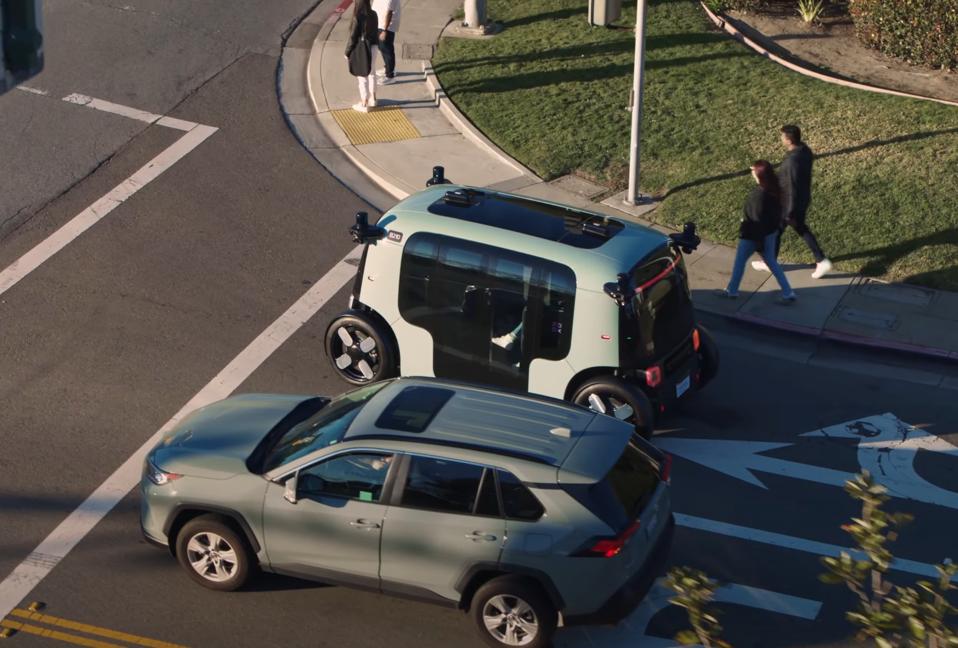
A Zoox driving on a public road for the first time with no controls. Note that the Zoox is … [+] symmetrical, and has no front or back
Zoox
Zoox, the robotaxi company owned by Amazon, has always been a maverick in that it decided to begin by designing a custom vehicle from scratch. Every other major company has started by developing self-driving on a traditional car, though several plan to eventually build a completely new custom car when the time comes.
Zoox just announced that due to a new permit, they have now operated their different vehicle for the first time on public roads with no pedals or wheel, taking employees on rides. That’s a good milestone for Zoox. (Though Waymo did it in 2015, it should be noted, with their Firefly vehicle and a blind rider.)
An unusual feature of the Zoox is that it is fully symmetrical — it has no front or back, and travels in both directions. It can also steer with all 4 wheels. That means it never turns around, if it goes down a road or cul-de-sac, it just switches direction and looks natural doing it. This symmetrical design has been at the core of Zoox’s thinking from day zero. (The car shows is direction by lighting red lights and bars on the “rear” of the vehicle.)
It’s useful, but there’s little reason that slightly modified traditional electric cars can’t also go backwards. As long as they have sufficient sensors pointing backwards, it’s not a big deal to train robot software to drive in reverse. You end up steering with the back wheels, so turns are a little different, but for a robot there is not the issue humans have driving backwards, where it’s unfamiliar and hard to see.
If the car is electric — and almost all robotaxis, like Waymo’s Jaguar and Cruise’s Bolt and Origin are electric — then you can even go as fast as you want in reverse, as well.
(Even those opposed to cars going fast in reverse would probably want it in a rare emergency situation like the video above.)
Going backwards would be a great solution in a situation like the encounter on Jan 21 between a Cruise Bolt and a large fire. The vehicle got confused, and didn’t want to back out. If it could drive easily in reverse, it could also easily simply back up, move to the other side of the road and be on its way. A recent video of a Waymo car that failed to get let into a line of slow moving cars and was stuck in the oncoming lane shows another situation where just reversing direction would have solved the problem had cars been coming.
There are a few problems to solve, though:
Other drivers and pedestrians might freak out to see a car going fast in what appears to be reverse The car may need some additional lights on the back, and possibly a sensor beef-up. Regulators need to be OK with this, and with the idea of the “U-turn” that isn’t a U-turn at all, just a reversal of direction Passengers also must be OK with it
Most of these might be solved if this is just an emergency move, to be used only for a short time if it’s the best solution to a driving problem. Indeed, humans back up to solve problems, though they usually seek to turn around the moment they can, by use of a driveway or other space to 3-point turn or U-turn. A robot need not be in as much of a hurry — it’s perfectly safe and capable driving this way. The public would eventually get used to it.
Yes, the tail on a vehicle going backwards will swing in a way people like cyclists don’t expect, as it will be steered from behind. Aware of this, the cars should make sure to leave extra room for any other road users when they make a turn so nobody is at risk to be hit by that swing.
Of course, as soon as the cars find an opportunity to turn back around, they should take it.
It can be argued that LIDAR equipped cars in a city don’t really need full headlights in the “back.” The reversing lights they already have might do the job. LIDAR sees just fine in the dark, and even most visual perception involves streetlamps and the lights on other vehicles more than your own headlights. For a short distance and modest speeds only some basic LED low-beams would do the job. While a robcar could go backwards at highway speed, they are not going to do that. The car would have red lights on the traditional front to act as brake lights and running lights. It might also do its reverse operations only at lower speeds with the 4-way hazard lights on, just to alert people that something unusual is going on.
In the Zoox and Cruise Origin, some passengers sit backwards, and indeed the Zoox doesn’t even have a backwards. Some people don’t like sitting this way, others are fine. It’s actually safer to be facing backwards in the event of a forward collision, and forward collisions are the most dangerous. In slower rear-end collisions you prefer to face forward. I do not believe traditional cars are crash tested while driving in reverse, though these cars would also drive forward almost all the time. There could simply be some need to drive backwards a tiny bit more, and not at full speed.
In these early days of robocar testing, it also makes sense to give the cars more ways to get out of a bad situation, because they might get into them more often today. Here, Zoox again has an edge with their 4-wheel steering. That’s not something that will be easily added to cars, though some new vehicles like the Tesla Cybertruck have 4-wheel steering.
When the sensors are on the roof, it also means that even if there’s a bike on the back of the car which would block a human’s view, the robotaxi might still see just fine. There should be bike racks on these cars — one of the great attributes of the robotaxi is it allows the one-way car trip. If your commute is too long to do on a bicycle, you should be able to summon a robotaxi, stick your bike on the back, and when you get close enough to work, get off and ride — bypassing traffic and getting exercise. Same on the way home.
The ability to drive backwards as easily as you drive forwards is a superpower that robocars can have that helps them reduce congestion on the roads. Perhaps they should be ready to use it?