
Revolutionizing Market Making: Elixir Raises $2.1m To Advance Crypto Market Liquidity

Crypto market making protocol Elixir has closed a seed fundraising round, raising a total of $2.1m from an assortment of institutional funds and investors, with a goal of reimagining market making and bringing better liquidity, fairness, and transparency to the industry.
Market making is one of the most important industries within the cryptocurrency landscape, with firms comprising the vast majority of the liquidity and volume that enables the market to trade efficiently on a 24/7 basis.
Market Making and Its Role in the Crypto Market
There exist two types of market making within the industry: liquidity-for-hire and high-frequency trading (HFT). While HFT firms generate yield through the use of proprietary algorithms and advanced strategies, generating delta-neutral returns on micro-spread for liquid assets, liquidity-for-hire market making models require token projects to pay large percentages of their supply to firms in exchange for basic liquidity provisioning on their centralized exchange (CEX) pairs. This is the current industry standard for how DApps and protocols access liquidity on pairs.
In many cases, this model results in the market maker receiving 2-5%+ of a project’s total token supply in exchange for a 12 to 18 month contract. This is widely viewed by founders as a necessary evil.
Furthermore, virtually all centralized exchanges have stringent requirements for active market making for projects to gain and maintain listings.
Elixir Raises $2.1m, Aiming to Fix a Predatory Market Making Landscape
Today, Elixir announced that it raised $2.1m in a seed round with participation from names such as Commonwealth, FalconX, Arthur Hayes, Avalanche AVAX , ChapterOne, KuCoin, Gate, Betaworks, OP Crypto, Quantstamp and others.
Through a trustless, decentralized protocol, Elixir transforms market making, enabling everyone to participate in active market making on centralized and decentralized exchanges. The protocol aligns incentives for projects and brings full transparency to market making.
Via Elixir, token projects can now gain market making for their exchange pairs superior to what centralized firms would provide, while saving 99%+ on their costs. Projects can also see exactly how their liquidity is being provisioned, unlocking full transparency for all actors.
In addition, profits traditionally captured by market making firms are paid out to the token’s community. Community members can participate individually and earn subsidized returns in the form of token rewards.
Elixir is a fully composable protocol, enabling it to also target DeFi exchange pairs, actively provisioning targeted liquidity on concentrated liquidity AMMs and central limit orderbook DEXs. Elixir allows for venues and projects to incentivize active market making, and provides retail DeFi users with a single venue to easily make markets across DEXs and CEXs. Finally, exchanges themselves can directly integrate Elixir to enable retail participation in active, algorithmic market making.
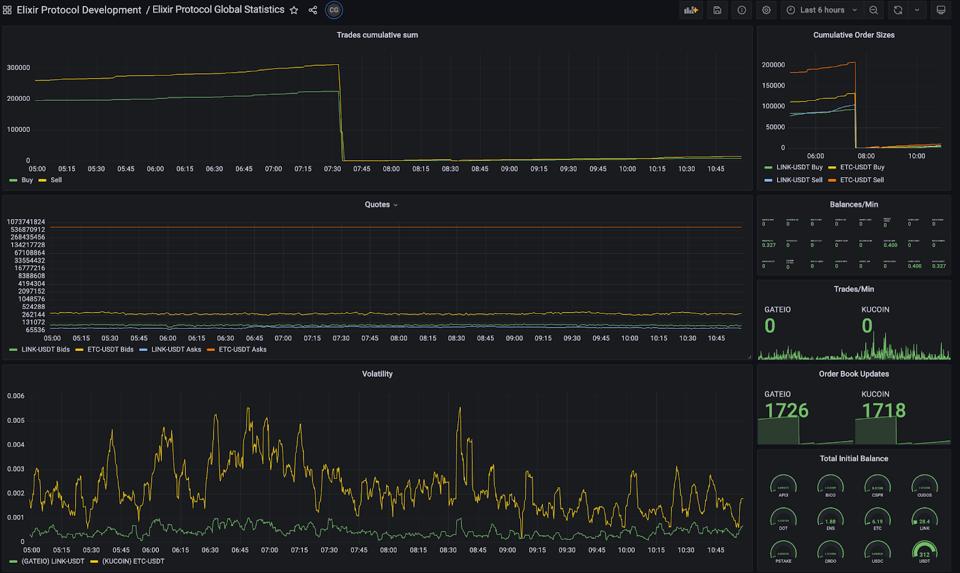
A Look at the Backend of Elixir’s Protocol
Elixir Protocol
Since the protocol is decentralized and open source, it also provides projects and token investors with much greater transparency and insights into how liquidity is being deployed – a stark difference to the traditionally “black box” nature of market making.
While speaking about the fundraise, Elixir founder Philip Forte expressed the potential for the protocol to integrate as core infrastructure across the crypto ecosystem:
“Elixir is actively working with top exchanges and projects to help provide more efficient and transparent liquidity to central limit order books. Projects will no longer be forced into paying predatory rates for crucial services, with Elixir helping build permanent and predictable liquidity bases for exchange pairs.”
Forte added that Elixir’s benefits don’t end at centralized exchange pairs, but will also benefit on-chain pairs.
“Once you have a decentralized protocol enabling projects to incentivize algorithmic liquidity provisioning on CEXs, you can apply the same infrastructure to on-chain orderbooks and AMM bonding curves. We’ve announced and are actively working on several integrations with notable decentralized exchanges.”
As mentioned above, the project has also announced some notable partnerships, including a backend, native integration into Perpetual Protocol to provide active, algorithmic market making on the platform’s multiple perpetual swap pairs – highlighting a DeFi use case for the service.
Other slated integrations listed on the protocol’s site include DyDx, Injective Labs, SudoSwap, Perennial, and Magpie.
Due to its trustless, off-chain infrastructure, Elixir supports both on-chain orderbooks, as well as concentrated liquidity AMMs (which are highly similar to traditional central limit order books) cross-chain.
With intentions of increasing the efficacy of liquidity deployment on both centralized and decentralized exchanges, Elixir aims to disrupt crypto’s market making landscape.